Navigate PIPEDA, Quebec Law 25, and AIDA to build an AI practice that is legally defensible, ethically sound, and client-first. Module 2 of 4 CVP® Designation.
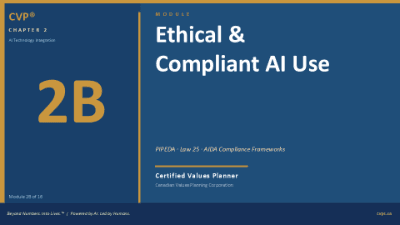
AI does not sit outside Canadian privacy law; it becomes another channel through which personal information is collected, stored, and used. This module gives Canadian financial advisors the regulatory framework to use AI confidently without becoming the test case that defines where the rules apply. This is Module 2 of 4 in Chapter 2 (AI Technology Integration) of the CVP® Designation, issued by Canadian Values Planning Corporation (CVPC). This course is designed for: CFP professionals who need to understand their PIPEDA obligations when using AI to process client financial, and personal data CLU and TEP advisors serving Quebec clients who face both Law 25 and PIPEDA compliance requirements. Compliance officers and practice managers building firm-wide AI governance policies Financial advisors who have been uncertain whether their current AI tool use is legally permissible CVP® candidates building an AI-integrated practice who need a documented consent and accountability framework.

CVP® (Certified Values Planner) Designation
Canadian Values Planning Corporation Issuing Body – CVP® (Certified Values Planner) Designation Who We Are Canadian Values Planning Corporation (CVPC) is the governing body behind the CVP® Certified Values Planner designation, Canada’s first AI-native financial planning credential. CVPC was founded on the belief that the future of financial advisory belongs to professionals who can seamlessly blend values-based human guidance with the power of modern AI tools. Our mission is clear: equip Canadian financial advisors with the credentials, methodology, and technology they need to thrive in an AI-enhanced world where technology amplifies human wisdom rather than replaces it. Operating under the guiding philosophy “Beyond Numbers. Into Lives. ™ Powered by AI. Led by Humans.” CVPC is committed to elevating the standard of financial planning across Canada. The CVP® Designation The CVP® (Certified Values Planner) is a rigorous, four-course professional designation designed to transform how financial advisors discover, understand, and act on the values that drive their clients’ most important decisions. Built around CVPC’s proprietary VALUES Framework™, the program bridges behavioral science, advanced planning strategy, and AI-powered workflow design preparing advisors to become true behavioral consultants rather than transactional salespeople. The Four-Course Curriculum 1. Values Planning Methodology & the VALUES Framework™ Foundational principles of values-based discovery, behavioral consulting, and client engagement using the VALUES Framework™. 2. AI Tools Integration for Financial Advisors Practical application of AI tools in client discovery, planning workflows, documentation, and compliance applied ethically and effectively. 3. Insurance & Estate Planning Applications Advanced strategies in life insurance, corporate planning, shared ownership structures, and estate transfer integrated within a values-driven advisory context. 4. Canadian Regulatory Landscape & Compliance Current Canadian regulatory requirements, privacy law (PIPEDA/Bill C-27), AML compliance, and building defensible, audit-ready AI-assisted workflows. Earning the CVP® Designation Upon successful completion of all four courses, graduates are formally invited to become CVP® designation holders joining a growing community of forward-thinking Canadian advisors committed to values-based, AI-enhanced practice. CVP® holders receive the right to use the designation after their name, are recognized in the CVPC national registry, and gain access to ongoing professional development, resources, and the broader CVPC advisor network. Optional Software Access – CVPC Platform As an added benefit, all students enrolled in CVP® courses may request optional access to the CVPC advisor platform purpose-built software designed to support the VALUES Framework™ in real client engagements. The platform provides AI-assisted discovery tools, compliance-defensible documentation workflows, and planning support giving advisors a practical environment to apply what they learn immediately in their practice. Students who wish to access the platform must submit a request by emailing info@cvpc.ca. Additional information about the platform is available at cvpc.ca. Beyond Numbers. Into Lives.™ Powered by AI. Led by Humans. cvpc.ca | info@cvpc.ca | 1-833-597-2676 | Toronto, Ontario, Canada
